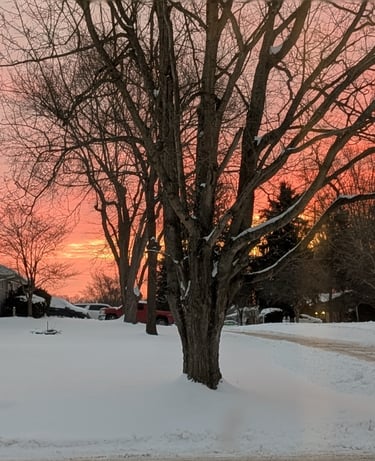


How To Stop Living in the Past
The Difference Between Understanding Your Past and Living There
Sometimes the hardest place to leave isn't a house, a relationship, or a job. Sometimes it's the version of ourselves that never got the chance to heal.
Life has a way of leaving scars.
Some are visible.
Most aren't.
If you've been through trauma, loss, heartbreak, illness, betrayal, or disappointment, your past has shaped you in ways that are very real. Understanding those experiences is important. In fact, it's often one of the first steps toward healing.
But there's a difference between understanding your past... and continuing to live there.
I've been thinking about this a lot lately.
Not because I have all the answers, but because I've seen what happens when people never leave the hardest chapter of their lives.
I've seen it in people I know.
I've seen it in myself.
And maybe you've seen it too.
Understanding Your Past Is Healthy
Let's get one thing straight before we go any further.
This isn't one of those articles that's going to tell you to "just get over it."
I don't believe in that.
Some things change us forever.
Losing someone you love changes you.
Being abused changes you.
Living through trauma changes you.
Surviving a serious illness changes you.
Those experiences become part of your story.
Ignoring them doesn't make them disappear.
Understanding why you react the way you do is healthy. It helps you recognize patterns, make sense of your emotions, and begin healing instead of simply surviving.
That's not weakness.
That's wisdom.
But Understanding Isn't the Same as Living There
Here's where the conversation gets a little harder.
Sometimes our past explains why we struggle.
Sometimes, after enough time has passed, we begin using it to explain why we never change.
Those are two different things.
Maybe your childhood explains why trusting people feels difficult.
Maybe a painful relationship explains why you're afraid to love again.
Maybe years of financial struggle explain why spending money makes you anxious.
Those things make sense.
But if every decision you make today is still being controlled by yesterday, then yesterday is still running your life.
And I don't think that's what any of us truly want.
There Comes a Time When Healing Asks Something of Us
This is the part people don't always like to hear.
Healing isn't something that simply happens while we wait.
At some point, we've got to participate.
Now, before you misunderstand me, I'm not saying it's fair.
Some people were handed burdens they never deserved.
Some wounds were caused by the choices of other people.
That isn't your fault.
But your future still belongs to you.
As unfair as it may feel, there comes a point when we have to decide whether we're going to let our pain keep making every decision... or whether we're going to slowly start making different ones.
Not because what happened no longer matters.
Because our future matters too.
Familiar Pain Can Feel Safer Than Growth
One of the hardest things about healing is that pain can become familiar.
Even when we hate it.
We know how to survive there.
We know what to expect.
Growth feels different.
Growth asks us to trust ourselves again.
To hope again.
To believe that life can still be good.
To take another chance after we've been hurt.
That's scary.
Sometimes staying stuck feels safer than risking disappointment one more time.
But familiar isn't always healthy.
Sometimes it's simply familiar.
Healing Doesn't Mean Forgetting
I think this is where people get confused.
Healing doesn't mean pretending it never happened.
It doesn't mean excusing someone who hurt you.
It doesn't mean acting like trauma wasn't real.
Healing means the pain no longer gets to make every decision for you.
You remember.
You learn.
You grow.
But you stop asking yesterday to determine every tomorrow.
That's freedom.
What Moving Forward Actually Looks Like
Moving forward isn't one big decision.
It's a hundred little ones.
You decide to ask for help.
You decide to go to counseling.
You decide to set healthier boundaries.
You decide to stop apologizing for things that were never your fault.
You decide to apologize for the things that were.
You decide to learn a new skill.
You decide to trust someone a little more than you did yesterday.
You decide to believe your life can still become something beautiful.
None of those choices erase the past.
They simply stop allowing the past to have the final word.
Your Future Deserves a Chance
One of the saddest things I've ever seen is someone who keeps reliving the same pain until it becomes their identity.
They're no longer just someone who survived something difficult.
They're someone who can't imagine themselves without it.
I understand how that happens.
Pain changes us.
But it doesn't have to become our permanent address.
Your story is bigger than the worst thing that ever happened to you.
There are still chapters you haven't written yet.
There are still people you haven't met.
There are still memories waiting to be made.
There are still parts of yourself you haven't discovered.
Don't let yesterday convince you that your life is already finished.
My Final Thoughts
I have deep compassion for people who are hurting.
I've had seasons that brought me to my knees.
I know what it feels like to wonder if life will ever feel normal again.
But I also know this.
At some point, healing asks us to take one small step.
Then another.
Then another.
Not because we're pretending the past didn't happen.
Because we finally decide that our future deserves the same attention we've been giving our past.
If you're finding it difficult to move forward, please know that you don't have to figure it all out on your own. Reaching out for help is not a sign of weakness. Sometimes it's one of the bravest decisions you'll ever make.
If you'd like to learn more about healing, trauma, resilience, and emotional well-being, these trusted organizations offer evidence-based information and resources:
American Psychological Association (APA): https://www.apa.org
National Center for PTSD (U.S. Department of Veterans Affairs): https://www.ptsd.va.gov
You may not have chosen what happened to you.
But you still get a voice in what happens next.
And I hope you never forget that.
A Note from Aunt Susie
This article is based on my personal experiences and is intended for informational purposes only. It is not a substitute for professional medical or mental health advice. If you're living with the effects of trauma, anxiety, depression, grief, or another mental health concern, please consider reaching out to a qualified healthcare or mental health professional. Healing is not a sign of weakness. It's one of the strongest things you'll ever choose to do.